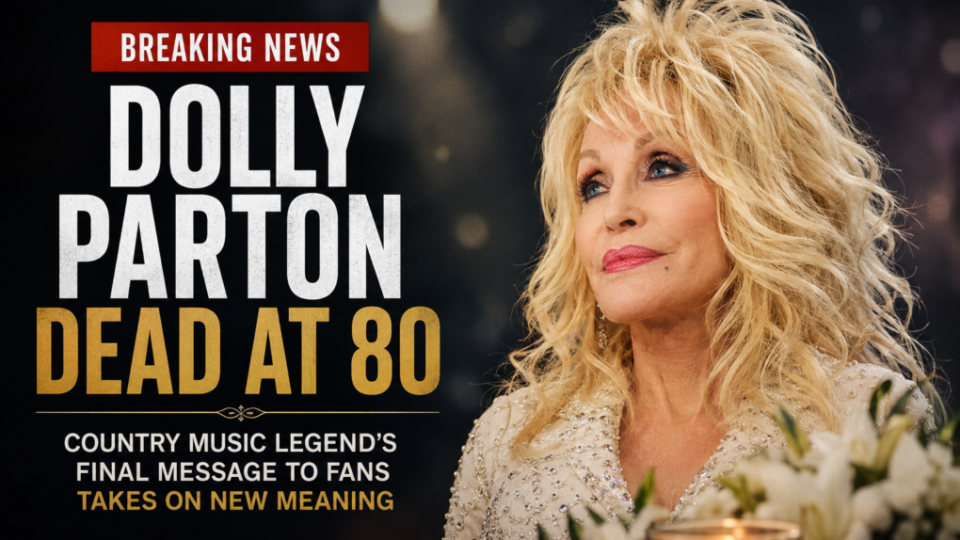
Country music legend Dolly Parton has died at the age of 80, bringing an extraordinary seven-decade career to an end just days after she spoke publicly about her health, her future and the many things she still hoped to accomplish.
The world has lost one of its most recognizable and beloved entertainers.
Dolly Parton, the singer, songwriter, actress, entrepreneur and philanthropist whose unmistakable voice and larger-than-life personality made her a global cultural icon, died Tuesday, August 25, 2026, in Nashville, Tennessee. She was 80 years old.
Her death was announced by her family, with her nephew Bryan Seaver delivering the difficult news in a video shared publicly. Parton’s representative said she died peacefully in Nashville.
An official cause of death had not been publicly announced at the time of publication.
The news sent shockwaves through the entertainment industry and among generations of fans who grew up with songs including “Jolene,” “9 to 5,” “Coat of Many Colors” and “I Will Always Love You.”
But what makes Parton’s death particularly poignant is how optimistic she remained until almost the very end.
Dolly Parton’s Final Interview Was Filled With Plans for the Future
Only four days before her death, Parton spoke about her health and career in an interview published August 21.
She acknowledged that she had been dealing with health problems, explaining that she had neglected some of her own needs while caring for her husband, Carl Dean, before his death in March 2025.
Yet Parton did not speak like someone preparing to say goodbye.
Instead, she was looking ahead.
Even while recovering, she said she was still working and added the now-heartbreaking words:
“I still have so many things I want to achieve.”
Parton said she intended to continue working for as long as she could in order to bring her remaining ideas to life.
Those words have taken on an entirely different meaning following her death.
Despite experiencing health difficulties and reducing some of her live commitments, Parton continued planning new projects. She discussed future performances and even emerging technology that could allow her presence and music to remain part of live entertainment in new ways.
She also made clear that although traditional touring was becoming increasingly difficult, she had no intention of simply disappearing.
For Dolly Parton, apparently, retirement was never really part of the plan.
Recent Health Issues Had Caused Concern
There had been signs that Parton was slowing down physically.
She had previously postponed a Las Vegas residency while dealing with health challenges and more recently appeared remotely rather than attending some events in person.
In her final interview, Parton acknowledged that she was going through a difficult period with her health, while reassuring fans that she was continuing to recover and work.
Her husband Carl Dean’s death also profoundly affected her.
Dean died on March 3, 2025, at the age of 82 after nearly six decades of marriage to Parton. Unlike his internationally famous wife, Dean remained intensely private and rarely appeared at public events.
Parton subsequently spoke about having to rebuild herself emotionally, spiritually and physically after losing the man who had been beside her for most of her adult life.
Still, her death came as a tremendous shock.
Only days earlier, she was publicly discussing new projects and the future.
From a Tennessee Cabin to Global Stardom
Dolly Rebecca Parton’s story has long seemed almost impossible.
She was born January 19, 1946, in rural Tennessee and grew up as one of 12 children in a family with very little money.
Her Appalachian childhood would later become one of the most important sources of her songwriting.
Parton began singing at church, appeared on local television while still a child and performed at Nashville’s Grand Ole Opry as a teenager.
After moving to Nashville, she began building a career as a songwriter before becoming a performer in her own right.
Her national breakthrough was accelerated by appearances alongside Porter Wagoner beginning in the late 1960s. But Parton was determined to establish herself independently.
The decision produced one of country music’s greatest careers.
Over the decades that followed, Parton wrote hundreds of songs and became one of the rare country performers capable of crossing effortlessly into pop culture without abandoning her roots.
The Songwriting Genius Behind “Jolene” and “I Will Always Love You”
The wigs, rhinestones and self-deprecating humor sometimes threatened to overshadow just how exceptional Dolly Parton was as a songwriter.
But behind the carefully constructed public image was one of the most important composers in modern popular music.
“Jolene” became a country standard recognized around the world.
“Coat of Many Colors,” inspired by her childhood, turned poverty and family love into one of Parton’s most enduring autobiographical songs.
Then there was “I Will Always Love You.”
Parton originally wrote and recorded the song as a farewell to Porter Wagoner after deciding to leave his television show and pursue her solo career.
Nearly two decades later, Whitney Houston transformed it into one of the biggest pop recordings in history through her version for The Bodyguard.
The extraordinary success introduced Parton’s songwriting to another generation and provided a reminder that underneath the glamour was a remarkably sophisticated storyteller.
Across her career, Parton sold more than 100 million records worldwide and accumulated decades of chart success.
Hollywood Success and “9 to 5”
Parton’s ambitions were never confined to Nashville.
In 1980, she made her feature-film debut alongside Jane Fonda and Lily Tomlin in 9 to 5.
The workplace comedy became a major success, while Parton’s title song became one of the defining hits of her career.
She later appeared in movies including The Best Little Whorehouse in Texas and the beloved 1989 drama Steel Magnolias, in which she played beauty salon owner Truvy Jones.
Her Steel Magnolias co-stars were among the many performers paying tribute following news of her death, reflecting the affection Parton inspired far beyond country music.
Dollywood Turned Dolly Into an Entrepreneurial Powerhouse
Parton also transformed her name into a major business empire.
Her best-known venture became Dollywood, the Tennessee theme park that grew into one of the region’s most significant tourist attractions.
But unlike many celebrity-branded businesses, Dollywood was deeply connected to Parton’s childhood home in the Great Smoky Mountains.
The project helped create jobs and attract visitors to the region from which she came.
That connection remained central to Parton’s public identity.
No matter how famous she became, she continually returned to Tennessee — physically, creatively and philanthropically.
Her Greatest Legacy May Be Millions of Children’s Books
For all her commercial achievements, Parton repeatedly demonstrated that she wanted her success to benefit other people.
One of the clearest examples was Dolly Parton’s Imagination Library.
Parton founded the program in 1995, inspired in part by her father’s inability to read and write. The initiative began by providing books to young children in her home county and eventually expanded internationally.
Millions of books have since been distributed to children, with free books arriving directly at families’ homes.
It became one of the largest and most recognizable early-childhood literacy initiatives in the world.
Her philanthropy extended far beyond literacy.
Following devastating Tennessee wildfires in 2016, Parton helped provide financial assistance to affected families.
She also famously contributed funding to research at Vanderbilt University Medical Center that supported development work connected to the Moderna COVID-19 vaccine.
Parton’s charitable work transformed her from simply a famous singer into something much rarer: a celebrity admired by people who might otherwise agree on very little.
She Refused to Let Fame Separate Her From Her Audience
Part of Parton’s extraordinary longevity came from her ability to understand exactly what the public thought of her — and laugh along with them.
She joked about her appearance before anyone else could.
She embraced enormous blonde wigs, towering heels, rhinestones and deliberately extravagant outfits.
Yet underneath the spectacle was an unusually sharp understanding of her own identity.
She could enter rooms filled with Hollywood celebrities, country musicians, business leaders or ordinary families and somehow remain unmistakably Dolly.
That authenticity helped her transcend generations.
Parents who listened to her records introduced her music to their children. Younger audiences discovered her through movies, television appearances, collaborations and social media.
She became simultaneously old-fashioned and timeless.
Carl Dean Was the Private Love Behind Her Public Life
Away from the cameras, Parton’s life was anchored for almost 60 years by Carl Thomas Dean.
The pair met in Nashville in 1964 and married in 1966.
Their marriage became famous partly because Dean wanted almost nothing to do with fame.
While Parton traveled the world and became one of America’s most photographed entertainers, Dean largely remained outside the spotlight.
They never had children, but Parton frequently spoke about her enormous extended family and the countless children reached through her charitable work.
Dean’s death in March 2025 marked the beginning of an emotionally difficult final chapter for Parton.
She continued creating, working and appearing publicly, but openly acknowledged how deeply losing him had affected her.
Tributes Pour In From Across the World
Within hours of confirmation of Parton’s death, tributes began appearing from musicians, actors and public figures.
Artists including Reba McEntire, Kacey Musgraves and others reflected on Parton’s influence, while performers who had worked alongside her remembered a person whose warmth away from the cameras matched the personality audiences saw publicly.
Her Steel Magnolias colleagues also shared emotional memories of their former co-star.
The response demonstrated just how unusual Parton’s position in American culture had become.
She wasn’t simply respected.
She was loved.
A Private Farewell for a Very Public Life
According to the statement released following her death, a small private service is planned for immediate family.
Fans around the world have been encouraged to celebrate Parton’s life and legacy, while donations to Dolly Parton’s Imagination Library have been suggested in lieu of flowers.
It is a fitting request.
For someone who accumulated enormous fame, wealth and recognition, one of Parton’s most lasting projects was simply putting books into children’s hands.
Dolly Parton’s Legacy Will Outlive the Rhinestones
There will inevitably be discussions in the coming days about Dolly Parton’s greatest song, greatest performance or most important achievement.
There may never be a single answer.
For country music fans, she was one of the genre’s greatest songwriters.
For movie audiences, she was Doralee Rhodes in 9 to 5 or Truvy in Steel Magnolias.
For Tennessee, she was a hometown hero who never abandoned the mountains that shaped her.
For millions of children, whether they realized it or not, she was the woman whose literacy program placed their first books in their homes.
And for the entertainment industry, she represented something increasingly difficult to manufacture: genuine affection across generations.
Dolly Parton spent much of her life joking about her carefully exaggerated appearance, but there was little artificial about the emotions contained in her songs.
She wrote about jealousy, poverty, heartbreak, ambition, devotion and leaving the people you love.
Perhaps that is why the final words she shared publicly now feel so difficult to read.
Four days before her death, Parton wasn’t talking about an ending.
She was talking about what she wanted to do next.
She still had dreams.
She still had projects.
She was, as she put it, “still workin’.”
Dolly Parton was 80 years old.
Her husband, Carl Dean, preceded her in death in 2025.
And although one of the brightest figures in American entertainment is now gone, the music, stories, generosity and unmistakable spirit she left behind will be extraordinarily difficult to forget.